

Connecting DBT and ACT in Mindful Connections
I am the facilitator of the Mindful Connections outpatient therapy groups at Tranquil Lotus Collaborative (TLC), meeting Fridays at noon, Saturdays at 11am, and soon Friday evenings at 6pm. I wanted to let people know not only that I am working to integrate Acceptance and Commitment Therapy (ACT) into this group that was formally known as a DBT (Dialectical Behavior Therapy) group, but also how and why I intend to do so. I believe it is a logical integration because Dialectical Behavior Therapy (DBT) and Acceptance and Commitment Therapy (ACT) can together help individuals who may be struggling by combining emotional acceptance with practical, skills-based tools to manage intense emotions, reduce impulsive behaviors, and improve emotional stability. DBT provides concrete skills in distress tolerance and regulation, while ACT fosters psychological flexibility to live according to one’s values rather than emotional urges.
I believe it was a logical evolution to help individual clients get the most out of the group and to be able to support each other in their growth and development. Both DBT skills and ACT processes heavily emphasize mindfulness, acceptance, and balancing acceptance with change. Together they aim to foster psychological flexibility for a more value-driven life, with both emphasizing learning to notice thoughts and feelings without getting stuck and taking committed action toward valued living, despite internal discomfort. DBT's radical acceptance directly mirror ACT's acceptance, while both use present-moment awareness and aim for effective, meaningful behavior. To help explain this better, I have provided overviews of each of these modalities below.
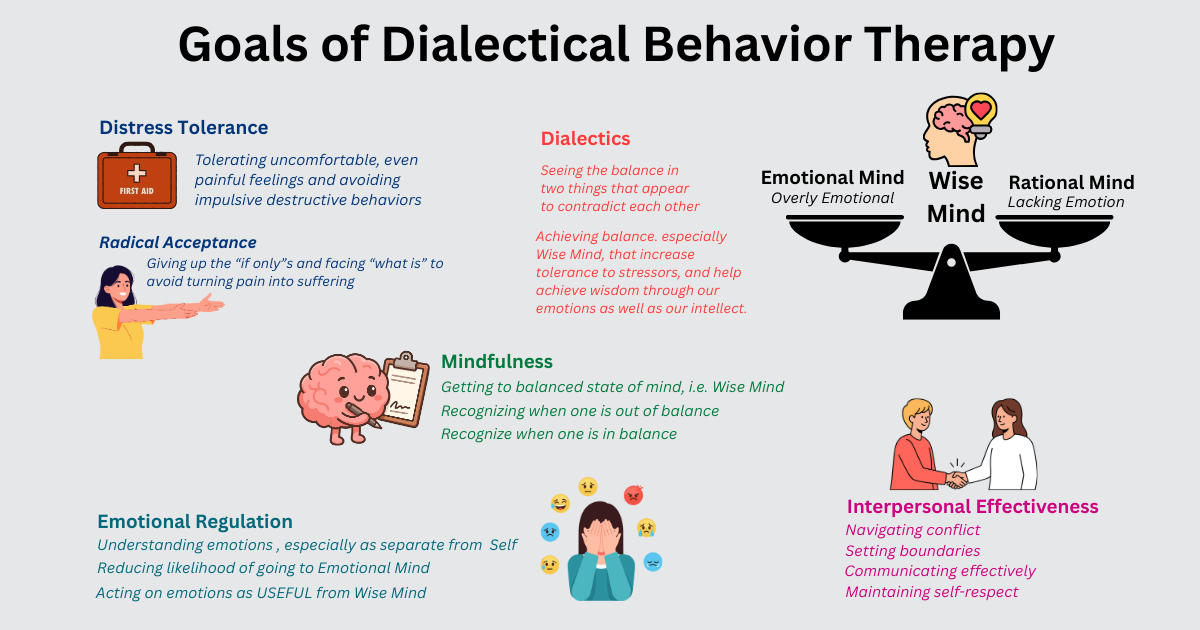
Figure 1
Dialectical Behavior Therapy (DBT) blends mindfulness and acceptance with behavioral change strategies, focusing on balancing acceptance of oneself with the need for change to manage intense emotions, improve relationships, and reduce harmful behaviors like self-harm or substance abuse, originally developed for Borderline Personality Disorder (BPD) but effective for many conditions, teaching core skills in mindfulness, distress tolerance, emotion regulation, and interpersonal effectiveness (Figure 1). While a full DBT program includes individual therapy, phone coaching, and a consultation team, as well as group skills training, the groups offered at Tranquil Lotus Collaborative have involved skills training as well as support for incorporation of DBT strategies, including especially DBT diary cards, in individual member’s individual therapy, whether or not that is at TLC.
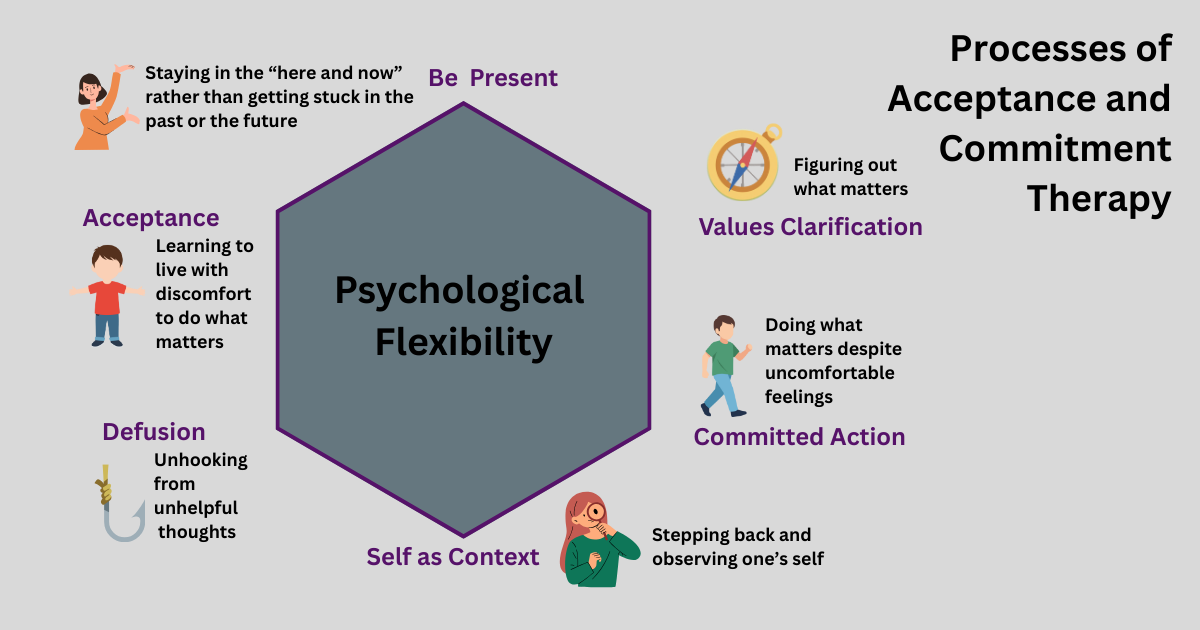
Figure 2
Acceptance and Commitment Therapy (ACT) is designed to help develop psychological flexibility—the ability to be present, open to experiences, and do what matters. It involves a non-linear client specific movement between six processes (Figure 2):
Be Present: Focusing on the “here and now” through mindfulness;
Self-as Context: recognizing your “observing self” as separate from your thoughts and feelings;
Acceptance: Making room for uncomfortable thoughts, feelings, and sensations rather than fighting them;
Defusion: Seeing thoughts as words, or pictures, not as facts;
Values: Identifying what matters to you to guide your life;
Committed Action: Taking steps toward your values, even when uncomfortable feelings arise.
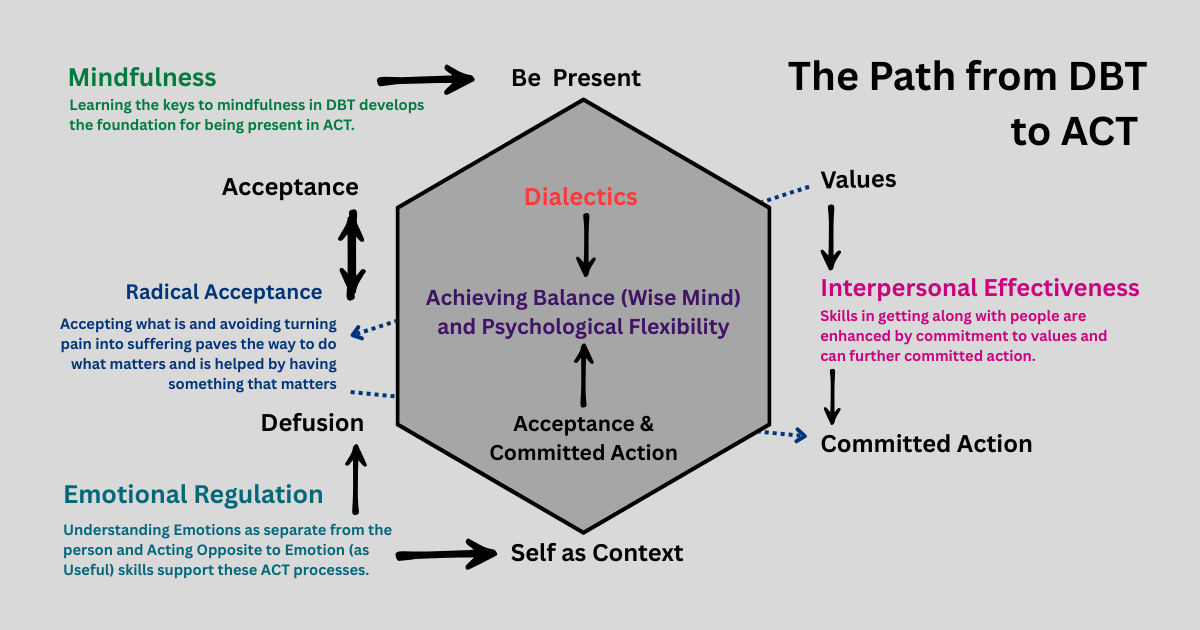
Figure 3
Some of the key similarities between DBT and ACT include:
Mindfulness and Present Moment: Both therapies teach present-moment awareness as fundamental for noticing internal experiences (thoughts, emotions, sensations) without judgment. Just as a person needs mindfulness to know when to use distress tolerance skills, including radical acceptance, as well as when and how to use emotional regulation skills like Acting Opposite to Emotion, mindfulness is also key to seeing oneself as separate from one’s emotions, accepting but not getting hooked by unhelpful thoughts, and keeping one’s values in mind moving forward.
Acceptance and Change: They both balance accepting difficult internal states (emotions, thoughts) with taking action for positive change, a core dialectic in DBT and central to ACT's psychological flexibility.
Emotional Regulation: Both help individuals reduce fighting uncomfortable feelings, moving from suppression to healthy management and acceptance.
Values-Based Action: While it is not always as emphasized in DBT skills training, both modalities encourage identifying core values and committing to actions aligned with them, leading to a richer, more meaningful life. Indeed, it has been said that DBT was developed to help people build a life worth living.
Behavioral Roots: Both originate from behavioral traditions and focus on practical skills to change patterns, not just understand them.
As the Mindful Connection group evolves, various connections will be made between the DBT skills that have always been present and ACT processes, periodically reviewing the ACT Hexaflex (Figure 2) as well as an overview of DBT philosophy goals and key domains (Figure 1). Some of the primary ways that these connections will be made are illustrated in Figure 3. As noted above, mindfulness is a key skill in both, and this will be referenced often when teaching and reviewing mindfulness skills. The similarities between Radical Acceptance in DBT and Acceptance in ACT will be drawn. As group members develop their emotional regulation skills, they will have the opportunity to connect with a number of the ACT processes, including Self as Context and Defusion. The Reducing Emotional Vulnerability skill, for example, includes collecting long term pleasant experiences in part by identifying one’s values. Interpersonal Effectiveness skills will provide an excellent opportunity to show how these skills are impacted by one’s values, both in terms of outcomes but also in terms of behaviors, while committed action can be an effective motivator to improve those skills.
In addition to learning skills and perspectives of DBT and ACT, group therapy offers a supportive environment where members reduce isolation, gain diverse perspectives, and build crucial social skills. By connecting with peers facing similar challenges, participants experience increased accountability, self-confidence, and a sense of belonging. If you or someone you know might benefit from joining one of these groups (Fridays at 11am, Fridays at 6pm or Saturdays at 11am) email or call Lori Steffen at 402.256.7883 for more information or complete the referral form.
.
